ISSN 1672-9242
CN 50-1247/X
CN 50-1247/X
1 Scope of Contributions
The journal focuses on the entire life cycle of equipment, with a distinctive emphasis on environmental engineering issues related to weaponry and military equipment. It primarily publishes original research articles and review papers in the fields of environmental adaptability design and analysis, environmental testing and evaluation, environmental effects and protection, general quality characteristics of equipment, and service life assessment.
The journal maintains the following permanent columns: Military Equipment, Aerospace Equipment, Naval and Marine Engineering Equipment, and Major Engineering Equipment; in addition, it features invited special issues and special-topic columns: Environmental Testing and Observation, Power Grid Equipment, and Oil and Gas Pipeline Corrosion Prevention and Control. Authors should select the appropriate column when submitting their manuscripts.
2 Manuscript Preparation Requirements
Manuscripts should demonstrate originality, novelty, scientific rigor, significance, readability, and clarity of expression. They shall be written concisely, with key points highlighted, data presented accurately, and conclusions drawn credibly.
2.1 Title
The title should be concise and informative, accurately reflecting the main content of the paper. It should generally not exceed 20 words. Symbols, abbreviations, acronyms, and trade names should be avoided whenever possible. All manuscripts must be accompanied by an English title, which should correspond exactly to the Chinese title.
2.2 Authors and Affiliations
Author names shall be listed beneath the article title. The first affiliation listed shall be the institution to which the intellectual property rights of the reported research belong. Where authors are affiliated with multiple institutions, the full name of each institution must be indicated. The names, year of birth, gender, academic qualifications, professional titles, and main research interests of the first author and the corresponding author must be provided in both Chinese and English.
2.3 Abstract and Keywords
1) Abstract. Both Chinese and English abstracts are required. The Chinese abstract shall be no fewer than 300 words. For original research articles, the Chinese abstract should be structured into four parts: Objective, Methods, Results, and Conclusion. It should elaborate the research content in detail and present the principal data. The Objective section should state the purpose for conducting the study—not merely restate the article title or describe the research content. The English abstract should employ the past tense for describing the research and the present tense for stating conclusions.
2) Keywords. 6-8 keywords should be provided beneath both the Chinese and English abstracts.
2.4 Main Text
To ensure the richness and readability of the paper, the main text (excluding abstract and references) should exceed 3,500 words, and the analysis should be sufficiently in-depth. Original research articles should comprise the following sections: Introduction, Experimental Methods, Results and Discussion, and Conclusion. The following requirements apply: the thesis argument must be clearly articulated; the supporting evidence must be sound (i.e., experimental and measurement data, figures, and tables must be accurate and error-free); the reasoning must be thorough (i.e., the discussion, results analysis, and mechanistic investigation should be detailed yet not redundant); and the conclusion must be comprehensive.
1) Introduction
The introduction should elaborate the theoretical basis and background of the study (i.e., the rationale for conducting the research), provide an overview of the current state of research both domestically and internationally, state the expected outcomes of the study, cite directly relevant references, and articulate the advancement and innovation of the present work. The narrative should be clear and concise, and should not include the data or conclusions of the paper (to avoid duplication with the abstract).
2) Experiment
This section should be distinct from a standalone laboratory report. In principle, instruments and reagents should not be presented in separate subsections but should be described as they arise in the experimental procedure. The fundamental process of the research should be clearly delineated, with relevant literature cited. The reproducibility of the research must be ensured so that readers can verify the experiments based on the information provided.
3) Results and Discussion
Observed results should be presented in the main text and accompanying figures and tables in a logical sequence. Figures and tables should be referenced in the text before they appear, and should not span across section boundaries. Data should not be duplicated between the text and figures/tables. Images must be clear, with a resolution of no less than 300 dpi. Figures and tables should be numbered sequentially in the order of their first citation in the text. Figure captions and table titles should be concise (without detailed experimental conditions) and provided in both Chinese and English. Coordinate plots should include axis labels (indicating the physical quantity) and corresponding units (using the International System of Units); photographs should include a scale bar. If figures or tables are adapted from other publications, the source must be cited, and written permission from the copyright holder must be submitted along with the manuscript.
Nomenclature and terminology used in the text should conform to those approved and promulgated by the National Committee for Terms in Sciences and Technologies. Full names of Chinese and foreign terms should be used; abbreviations should be accompanied by their full form in parentheses upon first occurrence.
All units of measurement should conform to the statutory measurement units of the People's Republic of China. Percentage values involving concentration should specify the type of percentage (e.g., mass fraction, mole fraction, volume fraction).
4) Conclusion
The conclusion should emphasize the innovative and significant findings of the study, acknowledge its limitations, and present the viewpoints derived from the experimental results. It should not repeat data or other information already presented in the introduction or results sections. The potential implications of the findings and the significance of further research may be discussed, provided such extrapolation is grounded in the study's results.
2.5 Funding
If the reported research is supported by a grant, the name and grant number of the funding program must be acknowledged in both Chinese and English.
2.6 References
References should be limited to journal articles or books that the author has personally read and that have been published in recent years. The sequential numbering system should be adopted: references are numbered in the order of their first citation in the text, and the corresponding number is placed in square brackets as a superscript. Review papers should generally include no fewer than 35 references; original research articles should include no fewer than 25 references. References are listed at the end of the paper in the order of citation. The editorial office reserves the right to add or remove references that are deemed inappropriate or insufficient. Where the original source is in Chinese, an English citation must also be provided (using the English version as it appears in the original). Accuracy of references must be ensured. The citation formats are as follows:
(1) Journal article: [No.] Author. Title [J]. Journal Name, Year, Volume(Issue): Page range.
(2) Monograph: [No.] Author. Title [M]. Place of Publication: Publisher, Year: Page range.
(3) Dissertation: [No.] Author. Title [D]. Place of Publication: Publisher, Year: Page range.
(4) Conference proceedings: [No.] Author. Title [C]//Title of Proceedings. Place of Publication: Publisher, Year: Page range.
(5) Patent: [No.] Patent Holder. Patent Title: Country, Patent Number [P]. Date of Grant or Publication (YYYY-MM-DD).
(6) Standard: [No.] Standard Number, Standard Name [S].
(7) Electronic resource: [No.] Author. Title [EB/OL]. Source or URL of the electronic resource, Date of Publication or Update/Date of Citation (optional).
Where there are no more than three authors, all should be listed, separated by commas. Where there are four or more authors, only the first three should be listed, followed by “et al.” In English references, the author's surname should be written in full, followed by the given name(s). Journal names in references should be cited using their standard full titles.
3 Manuscript Processing
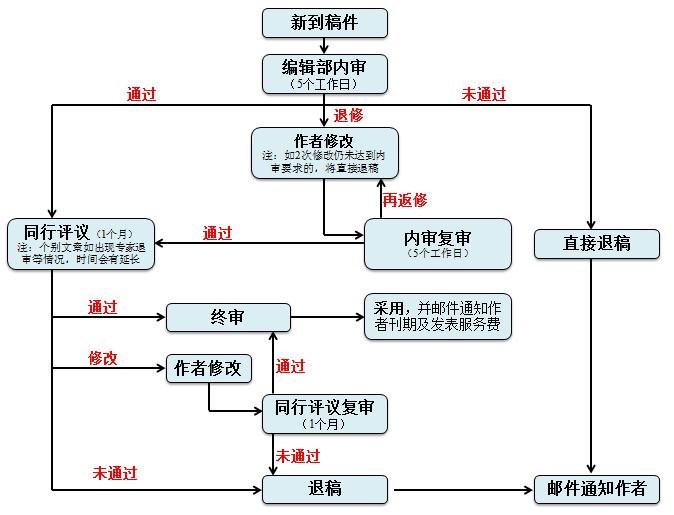
The manuscript processing workflow comprises: Submission → Internal Review → Peer Review → Final Decision. All steps are conducted online; offline submissions are not accepted.
Authors should register an account on the journal website (www.eee-j.com) before submitting their manuscripts. After submission, authors may log in at any time to check the processing status. Before submission, authors are expected to read these guidelines carefully. Submission of a manuscript is deemed to constitute the author's acknowledgment, understanding, and acceptance of the content and requirements of these guidelines. Authors are requested to provide accurate information regarding the article and authors upon submission, so as not to impede the processing schedule.
The editorial office reserves the right to make necessary editorial revisions to manuscripts. Authors who do not consent to such revisions should state this in advance. The editorial office will notify authors of the acceptance or the review decision within 60 days. Authors who have not received a notification should promptly inquire with the editorial office. Prior to receiving a notification, authors should not submit the manuscript to any other journal.
4 Confidentiality Requirements
(1) All authors of a manuscript must ensure that its content does not involve state secrets, commercial secrets, work secrets, or politically sensitive information. The research grants supporting the paper must not be classified (i.e., designated with a confidentiality level). The copyright-affiliated institution must be one whose name may be publicly disclosed. Authors shall bear full responsibility should any related issues arise.
(2) All manuscripts that have passed peer review and are accepted for publication must be accompanied by a “Confidentiality Review Certificate” bearing the official red seal of the author's institution or its competent administrative department. (A template is available for download in the “Download Zone” on the journal's official website.)
5 Copyright Transfer
Before submission, authors should carefully review the content of the journal's “Copyright Transfer Agreement” (available for download in the “Download Zone” on the journal website). Upon submission, the journal presumes that authors have read and understood the “Copyright Transfer Agreement” and agree to transfer to the journal, on a worldwide basis, the rights of revision, reproduction, distribution, network communication, translation, and compilation inherent in the copyright of the paper.
Upon receiving the acceptance notification, authors should promptly submit the “Copyright Transfer Agreement” signed by all listed authors. Upon receipt of the signed agreement, the editorial office will arrange for the publication of the article.
6 Publication Fees
For articles accepted for publication, the journal charges a publication service fee of RMB 1,500 per article.
For published articles, the journal pays an author's honorarium of RMB 200 per article, disbursed according to the remittance information registered by the author in the system.
7 Manuscript Appeals
Authors who disagree with the review decision may file an appeal with the editorial office. The appeal should address the specific review comments in question and provide detailed reasons for the dissent.
Upon receipt of an appeal, the editorial office will designate personnel to verify the issues raised. If the appeal is found to be justified, a third-party arbitration review will be arranged as soon as possible.
8 Publication Timeline
The journal is published monthly. The editorial office finalizes the electronic version of each issue on the 25th of the month, after which it is submitted to various database platforms for processing and printing.
The date on which an article becomes retrievable in the various databases depends on each platform's data processing cycle, which typically ranges from 4 to 8 weeks.
9 Print Copies and Full-Text Access
Authors will receive complimentary print copies in the beginning of the month following publication at a rate of two copies per article. Print copies may also be obtained by subscription; details are available under “Subscription” on the journal website.
All authors may access the full text of articles free of charge through the journal website, the VIP (Chongqing VIP) database, and the Wanfang Data Knowledge Service Platform. Full texts are also available through the China National Knowledge Infrastructure (CNKI).
For any other special circumstances, please contact the editorial office. Contact information is available under “Contact Us” on the journal website.
10 Archiving
The journal maintains archives of print copies and electronic data for the most recent 10 years.
Appendix: Manuscript Processing Workflow and Timeline for Equipment Environmental Engineering. (After authors have paid the page fee, they must promptly register the payment on the official website to facilitate fee verification and registration.)